Paramore - Lets The Flames Begin LIVE
Paramore - Born For This LIVE
Paramore - Pressure LIVE
Paramore - Thats What You Get LIVE
Paramore - Thats What You Get LIVE (acoustic)
Paramore - Decode LIVE
Paramore - Emergency LIVE
Paramore - Crush,crush,crush LIVE
Paramore - Whoa LIVE
Paramore _Decoy Final Riot LIVE
Showing posts with label guitar. Show all posts
Showing posts with label guitar. Show all posts
Sunday, September 5, 2010


Friday, September 3, 2010
VIDEO
Extreme - Decade Dance (by Girls)
Extreme - Cupid Dead Guitar cover
Paramore - Letes The Flame Begin MTV Live
come up to the room to download video download
Saturday, August 21, 2010
Pickups
Compared to an acoustic guitar, which has a hollow body, electric guitars make comparatively little audible sound simply by having their strings plucked, and so electric guitars are normally plugged into a guitar amplifier, which makes the sound louder. When an electric guitar is strummed, the movement of the strings generates (i.e., "induces") a very small electrical current in the magnetic pickups, which are magnets wrapped with coils of very fine wire. That current is then sent through a cable to a guitar amplifier. The current induced is proportional to such factors as the density of the string or the amount of movement over these pickups. That vibration is, in turn, affected by several factors, such as the composition and shape of the body.

A close-up of the pickups on a Fender Squier "Fat Strat" guitar; on the left is a "humbucker" pickup and on the right are two single-coil pickups.
Some "hybrid" electric-acoustic guitars are equipped with additional microphones or piezoelectric pickups (transducers) that sense mechanical vibration from the body. Because in some cases it is desirable to isolate the pickups from the vibrations of the strings, a guitar's magnetic pickups will sometimes be embedded or "potted" in epoxy or wax to prevent the pickup from having a microphonic effect.
Because of their natural inductive qualities, all magnetic pickups tend to pick up ambient and usually unwanted electromagnetic noises. The resulting noise, the so-called "hum", is particularly strong with single-coil pickups, and aggravated by the fact that very few guitars are correctly shielded against electromagnetic interference. The most frequent cause is the strong 50 or 60 Hz component that is inherent in the generation of electricity in the local power transmission system. As nearly all amplifiers and audio equipment associated with electrical guitars rely on this power, there is in theory little chance of completely eliminating the introduction of unwanted hum.
Double-coil or "humbucker" pickups were invented as a way to reduce or counter the unwanted ambient hum sounds (known as 60 cycle hum). Humbuckers have two coils of opposite magnetic and electric polarity. This means that electromagnetic noise hitting both coils should cancel itself out. The two coils are wired in phase, so the signal picked up by each coil is added together. This high combined inductance of the two coils leads to the richer, "fatter" tone associated with humbucking pickups. Optical pickups are a type of pickup which sense string and body vibrations using infrared LED light.
Some "hybrid" electric-acoustic guitars are equipped with additional microphones or piezoelectric pickups (transducers) that sense mechanical vibration from the body. Because in some cases it is desirable to isolate the pickups from the vibrations of the strings, a guitar's magnetic pickups will sometimes be embedded or "potted" in epoxy or wax to prevent the pickup from having a microphonic effect.
Because of their natural inductive qualities, all magnetic pickups tend to pick up ambient and usually unwanted electromagnetic noises. The resulting noise, the so-called "hum", is particularly strong with single-coil pickups, and aggravated by the fact that very few guitars are correctly shielded against electromagnetic interference. The most frequent cause is the strong 50 or 60 Hz component that is inherent in the generation of electricity in the local power transmission system. As nearly all amplifiers and audio equipment associated with electrical guitars rely on this power, there is in theory little chance of completely eliminating the introduction of unwanted hum.
Double-coil or "humbucker" pickups were invented as a way to reduce or counter the unwanted ambient hum sounds (known as 60 cycle hum). Humbuckers have two coils of opposite magnetic and electric polarity. This means that electromagnetic noise hitting both coils should cancel itself out. The two coils are wired in phase, so the signal picked up by each coil is added together. This high combined inductance of the two coils leads to the richer, "fatter" tone associated with humbucking pickups. Optical pickups are a type of pickup which sense string and body vibrations using infrared LED light.
Tremolo arms
Some electric guitars have a tremolo arm (sometimes called a "whammy bar" or "vibrato arm" and occasionally abbreviated as trem), a lever attached to the bridge which can slacken or tighten the strings temporarily, changing the pitch, thereby creating a vibrato or a portamento effect. Early vibrato systems, such as the Bigsby vibrato tailpiece, tended to be unreliable and cause the guitar to go out of tune quite easily, and also had a limited range. Later Fender designs were better, but Fender held the patent on these, so other companies used Bigsby-style vibrato for many years.

Detail of a Squier-made Fender Stratocaster. Note the vibrato arm, the 3 single-coil pickups, the volume and tone knobs.
With the expiration of the Fender patent on the Stratocaster-style vibrato, various improvements on this type of internal, multi-spring vibrato system are now available. Floyd Rose introduced one of the first improvements on the vibrato system in many years when in the late 1970s he began to experiment with "locking" nuts and bridges which work to prevent the guitar from losing tuning even under the most heavy whammy bar acrobatics.
With the expiration of the Fender patent on the Stratocaster-style vibrato, various improvements on this type of internal, multi-spring vibrato system are now available. Floyd Rose introduced one of the first improvements on the vibrato system in many years when in the late 1970s he began to experiment with "locking" nuts and bridges which work to prevent the guitar from losing tuning even under the most heavy whammy bar acrobatics.
Guitar necks
Electric guitar necks can vary according to composition as well as shape. The primary metric used to describe a guitar neck is the scale, which is the overall length of the strings from the nut to the bridge. A typical Fender guitar uses a 25.5 inch scale, while Gibson uses a 24.75 inch scale in their Les Paul. While Gibson's scale has often claimed to be 24.75", it has varied through the years by as much as a half inch. The frets are placed proportionally according to the scale length; thus, the smaller the scale, the tighter the spacing of the frets.
Necks are described as bolt-on, set-in, or neck-through depending on how they are attached to the body. Set-in necks are glued to the body in the factory, and are said to have a warmer tone and greater sustain; this is the most traditional type of joint. Bolt-on necks were pioneered by Leo Fender to facilitate easy adjustment and replacement of the guitar neck. Neck-through instruments extend the neck itself to form the center of the guitar body, and are known for long sustain and for being particularly sturdy. While a set neck can be carefully unglued by a skilled luthier, and a bolt-on neck can simply be unscrewed, a neck-through design is difficult or even impossible to repair, depending on the damage. Historically, the bolt-on style has been more popular for ease of installation and adjustment; since bolt-on necks can be easily removed, there is an after-market in replacement bolt-on necks from companies such as Warmoth and Mighty Mite. Some instruments, notably most Gibson models, have continued to use set/glued necks. Neck-through bodies are somewhat more common in bass guitars.
Electric guitar necks can vary according to composition as well as shape. The primary metric used to describe a guitar neck is the scale, which is the overall length of the strings from the nut to the bridge. A typical Fender guitar uses a 25.5 inch scale, while Gibson uses a 24.75 inch scale in their Les Paul. While Gibson's scale has often claimed to be 24.75", it has varied through the years by as much as a half inch. The frets are placed proportionally according to the scale length; thus, the smaller the scale, the tighter the spacing of the frets.
Necks are described as bolt-on, set-in, or neck-through depending on how they are attached to the body. Set-in necks are glued to the body in the factory, and are said to have a warmer tone and greater sustain; this is the most traditional type of joint. Bolt-on necks were pioneered by Leo Fender to facilitate easy adjustment and replacement of the guitar neck. Neck-through instruments extend the neck itself to form the center of the guitar body, and are known for long sustain and for being particularly sturdy. While a set neck can be carefully unglued by a skilled luthier, and a bolt-on neck can simply be unscrewed, a neck-through design is difficult or even impossible to repair, depending on the damage. Historically, the bolt-on style has been more popular for ease of installation and adjustment; since bolt-on necks can be easily removed, there is an after-market in replacement bolt-on necks from companies such as Warmoth and Mighty Mite. Some instruments, notably most Gibson models, have continued to use set/glued necks. Neck-through bodies are somewhat more common in bass guitars.
The materials used in the manufacture of the neck have great influence over the tone of the instrument. Hardwoods are very much preferred, with maple, ash, and mahogany topping the list. The neck and fingerboard can be made from different materials, such as a maple neck with a rosewood fingerboard. In the 1980s, exotic man-made materials such as graphite began to be used, but are pricey and never have replaced wood in production instruments. Such necks can be retrofitted to existing bolt-on instruments.
There are several different neck shapes used on guitars, including shapes known as C necks, U necks, and V necks. These refer to the cross-sectional shape of the neck (especially near the nut). There are also several sizes of fret wire available, with traditional players often preferring thin frets, and metal shredders liking thick frets. Thin frets are considered better for playing chords, while thick frets allow lead guitarists to bend notes with less effort. An electric guitar with a neck which folds back called the "Foldaxe" was designed and built for Chet Atkins by Roger C. Field (featured in Atkins' book "Me and My Guitars."). Steinberger guitars developed a line of exotic instruments without headstocks, with tuning done on the bridge instead.
There are several different neck shapes used on guitars, including shapes known as C necks, U necks, and V necks. These refer to the cross-sectional shape of the neck (especially near the nut). There are also several sizes of fret wire available, with traditional players often preferring thin frets, and metal shredders liking thick frets. Thin frets are considered better for playing chords, while thick frets allow lead guitarists to bend notes with less effort. An electric guitar with a neck which folds back called the "Foldaxe" was designed and built for Chet Atkins by Roger C. Field (featured in Atkins' book "Me and My Guitars."). Steinberger guitars developed a line of exotic instruments without headstocks, with tuning done on the bridge instead.
Sound and effects
While an acoustic guitar's sound is largely dependent on the vibration of the guitar's body and the air within it, the sound of an electric guitar is largely dependent on a magnetically induced electrical signal, generated by the vibration of metal strings near sensitive pickups. The signal is then "shaped" on its path to the amplifier by using a range of effect devices or circuits that modify the tone and characteristics of the signal. The amplifiers and speakers used also add (intentional) coloration to the final sound.
While an acoustic guitar's sound is largely dependent on the vibration of the guitar's body and the air within it, the sound of an electric guitar is largely dependent on a magnetically induced electrical signal, generated by the vibration of metal strings near sensitive pickups. The signal is then "shaped" on its path to the amplifier by using a range of effect devices or circuits that modify the tone and characteristics of the signal. The amplifiers and speakers used also add (intentional) coloration to the final sound.
Built-in sound shaping
Electric guitars can have up to three magnetic pickups. Identically positioned pickups will have different tones depending on how near they are to the neck or bridge, with bridge pickups having a bright or trebley timbre, and neck pickups being more warm or bassey. The type of pickup also effects tone, with dual-coil pickups sounding warmer, thicker, perhaps even muddy, and single coil pickups sounding clear, bright, perhaps even biting. Guitars do not have to be fitted with a uniform type of pickup: a common mixture is the "fat strat" arrangement of one dual-coil at the bridge position, with single coils in the middle and neck positions.
Where there is more than one pickup, selector switching is fitted. These often allow the outputs of two or more pickups to be combined, so that two-pickup guitars have three-way switches, and three-pickup guitars have five-way switches. Futher circuitry is sometimes provided to combine the pickups in different ways. For instance, phase switching places one pickup out of phase with the other(s), leading to a "honky", "nasal", or "funky" sound. Individual pickups can also have their timbre altered by switches, typically coil tap switch, which effectively short-circuits some of a dual-coil pickup's windings, giving a tone like a single coil pickup.
The final stages of on-board sound-shaping circuitry are the volume control (potentiometer) and tone control (which "rolls off" the treble frequencies). Where there are individual volume controls for different pickups, and where pickup signals can be combined, they would affect the timbre of the final sound by adjusting the balance between pickups from a straight 50:50.
The strings fitted to the guitar also have an influence on tone. Rock musicians often prefer the lightest gauge of roundwound string, which are easier to bend, while jazz musicians go for heavier, flatwound strings with a rich, dark sound.
Recent guitar designs may incoporate much more complex circuitry than described above: see Digital and synthesizer guitars, below.
Classic amplifier sounds
In the 1960s, some guitarists began exploring a wider range of tonal effects by distorting the sound of the instrument. To do this, they used overdrive — increasing the gain, of the preamplifier beyond the level at which the signal could be faithfully reproduced, resulting in a "fuzzy" sound. This effect is called "clipping" by sound engineers, because when viewed with an oscilloscope, the wave forms of a distorted signal appear to have had their peaks "clipped off", approximating a square wave. This was not actually a new development in the instrument, but rather a shift of aesthetics, the sound having not been recognized as desirable previously.
Distortion achieved by overdrive necessarily involves high volumes and is therefore often combined with audio feedback.
After distortion became popular, amplifier manufacturers included various provisions for it, making amps easier to overdrive, and providing separate "dirty" and "clean" channels so that distortion could easily be switched in and out. The distortion characteristics of vaccuum tube amplifiers are particularly sought-after, and various attempts have been made to emulate them without the disadvantages (fragility, low power, expense) of actual tubes.
Guitar amplifiers have long included at least a few effects, often tone controls and a spring reverb unit. The use of offboard effects is assisted by the provision of effect loops, an arrangement that allows effects to be taken out of circuit when not required.
Effects units

In the 1960s, the tonal palette of the electric guitar was further modified by introducing an Effects unit in its signal path. modifiers, wave-shaping circuits, voltage-controlled oscillators, or digital delays. Effects units come in several formats, the most common of which are the stomp-box and the rack-mount unit. A "stomp box" (or "pedal") is a small metal or plastic box containing the circuitry which is placed on the floor in front of the musician and connected in line with the patch cord connected to the instrument. The box is typically controlled by one or more foot-pedal on-off switches and it typically contains only one or two effects. "Guitar pedalboards" are used by musicians who use multiple stomp-boxes; these may be a DIY project made with plywood or a commercial pedalboard.
A rack-mount effects unit may contain the identical electronic circuit, but is mounted in a standard 19" equipment rack. Usually, however, rack-mount effects units contain several different types of effects. They are typically controlled by knobs or switches on the front panel, and often by a MIDI digital control interface.
Typical effects include:-
• Effects such as stereo chorus, phasers and flangers which shift the pitch of the signal by a small and varying amount, creating swirling, shimmering and whooshing noises.
• Effects such as octavers, which displace pitch by an exact musical interval.
• Distortion, such as transistor-style fuzz, or effects incorporating or emulating vaccuum tube distortion.
• Filters such as wah-wah
• Envelope shapers, such as compression/sustain or volume/swell.
• Time-shift effects such as delay and reverb.
Not all special effects are electronic; in 1967, guitarist Jimmy Page of The Yardbirds and Led Zeppelin created unusual, psychedelic sound effects by playing the electric guitar using a violin bow with a delay pedal and wah pedal.
A rack-mount effects unit may contain the identical electronic circuit, but is mounted in a standard 19" equipment rack. Usually, however, rack-mount effects units contain several different types of effects. They are typically controlled by knobs or switches on the front panel, and often by a MIDI digital control interface.
Typical effects include:-
• Effects such as stereo chorus, phasers and flangers which shift the pitch of the signal by a small and varying amount, creating swirling, shimmering and whooshing noises.
• Effects such as octavers, which displace pitch by an exact musical interval.
• Distortion, such as transistor-style fuzz, or effects incorporating or emulating vaccuum tube distortion.
• Filters such as wah-wah
• Envelope shapers, such as compression/sustain or volume/swell.
• Time-shift effects such as delay and reverb.
Not all special effects are electronic; in 1967, guitarist Jimmy Page of The Yardbirds and Led Zeppelin created unusual, psychedelic sound effects by playing the electric guitar using a violin bow with a delay pedal and wah pedal.
Modern amplifier techniques
In the 1970s, as effects pedals proliferated, their sounds were combined with tube amp distortion at lower, more controlled volumes by using power attenuators such as Tom Scholz' Power Soak as well as re-amplified dummy loads such as Eddie Van Halen's use of a variac, power resistor, post-power-tube effects, and a final solid-state amp driving the guitar speakers. A variac is one approach to power-supply based power attenuation, to make the sound of power-tube distortion more practically available.
Recent amplifiers may include digital technology similar to modern effects pedals, including the ability to model or emulate a variety of classic amps.
Digital and software-based effects

A multi-effects device (also called a "multi-FX" device) is a single electronics effects pedal or rackmount device that contains many different electronic effects. In the late 1990s and throughout the 2000s, multi-FX manufacturers such as Zoom and Korg produced devices that were increasingly feature-laden. Multi-FX devices allow several of the effects to be used together, and most devices allow users to set "preset" combinations of different effects including distortion, chorus, reverb, compression, and so on. This allows musicians to have quick on-stage access to different effects combinations. Some multi-FX pedals for contain modelled versions of well-known effects pedals or amplifiers.

The Boss GT-8 is a higher-end multi-effect processing pedal; note the preset switches and patch bank footswitches and built-in expression pedal.
Multi-effects devices have garnered a large share of the effects device market because they offer the user such a large variety of effects in a single package. A low-priced multi-effects pedal may provide 20 or more effects for the price of a regular single-effect pedal. More expensive multi-effect pedals may include 40 or more effects, amplifier modelling, and the ability to combine effects and/or modelled amp sounds in different combinations, as if the user was using multiple guitar amps. More expensive multi-effects pedals may also include more input and output jacks (e.g., an auxiliary input or a "dry" output), MIDI inputs and outputs, and an expression pedal, which can control volume or modify effect parameters (e.g., the rate of the simulated rotary speaker effect).
By the 1980s and 1990s, software effects became capable of replicating the analog effects used in the past. These new digital effects attempted to model the sound produced by analog effects and tube amps, to varying degrees of quality. There are many free guitar effects computer programs for computers that can be downloaded via the Internet. Now, computers with sound cards can be used as digital guitar effects processors. Although digital and software effects offer many advantages, many guitarists still use analog effects.
Multi-effects devices have garnered a large share of the effects device market because they offer the user such a large variety of effects in a single package. A low-priced multi-effects pedal may provide 20 or more effects for the price of a regular single-effect pedal. More expensive multi-effect pedals may include 40 or more effects, amplifier modelling, and the ability to combine effects and/or modelled amp sounds in different combinations, as if the user was using multiple guitar amps. More expensive multi-effects pedals may also include more input and output jacks (e.g., an auxiliary input or a "dry" output), MIDI inputs and outputs, and an expression pedal, which can control volume or modify effect parameters (e.g., the rate of the simulated rotary speaker effect).
By the 1980s and 1990s, software effects became capable of replicating the analog effects used in the past. These new digital effects attempted to model the sound produced by analog effects and tube amps, to varying degrees of quality. There are many free guitar effects computer programs for computers that can be downloaded via the Internet. Now, computers with sound cards can be used as digital guitar effects processors. Although digital and software effects offer many advantages, many guitarists still use analog effects.
Synthesizer and digital guitars
In 2002, Gibson announced the first digital guitar, which performs analog-to-digital conversion internally. The resulting digital signal is delivered over a standard Ethernet cable, eliminating cable-induced line noise. The guitar also provides independent signal processing for each individual string. Also, in 2003 amp maker Line 6 released the Variax guitar. It differs in some fundamental ways from conventional solid-body electrics. For example it uses piezoelectric pickups instead of the conventional electromagnetic ones, and has an on-board computer capable of modifying the sound of the guitar to model the sound of many instruments.
Playing techniques
 The sound of a guitar is not only adapted by electronic sound effects, but also heavily by all kinds of new techniques developed or becoming possible in combination with the electric amplification. This is called extended technique.
Extended techniques include:-
• String bending (or radial finger vibrato.). This is not quite unique to the electric instrument, but is greatly facilitated by the light strings typically used on solid body guitars.
• The use of the whammy bar or "tremolo" arm, including the extreme technique of dive bombing.
• Tapping, in which both hands are applied to the fretboard. This is only feasiible with the assistance of amplification.
• Pinch harmonics.
• Use of audio feedback to enhance sustain and change timbre.
• Substitution of another device for the plectrum, for instance the violin bow (as famously used by Jimmy Page) and the e-bow, (a device using electromagnetic feedback to vibrate strings without direct contact). Like feedback, these techniques increase sustain, bring out harmonics and change the acoustic envelope.
• Sustainers built into the guitar itself
• Use of slide or bottlenecks.
• Sometimes guitars are even adapted with extra modifications to alter the sound, such as Prepared guitar and 3rd bridge.
Other techniques such as axial finger vibrato, pull-offs, hammer-ons, palm muting, harmonics and altered tunings are also used on the classical and acoustic guitar. Shred guitar is a genre involving a number of extended techniques.
History
History
The acoustic properties of a guitar and its potential as a polyphonic solo instrument made it a good candidate for amplification. The need for the amplified guitar became apparent during the big band era as orchestras increased in size, particularly when guitars had to compete with large brass sections. The first electric guitars used in jazz were hollow archtop acoustic guitar bodies with electromagnetic transducers. By 1932 an electrically amplified guitar was commercially available. Gibson's first production electric guitar, marketed in 1936, was the ES-150 model ("ES" for "Electric Spanish"; and "150" reflecting the $150 price of the instrument, along with a matching amplifier). The ES-150 guitar featured a single-coil, hexagonally shaped "bar" pickup, which was designed by Walt Fuller. It became known as the "Charlie Christian" pickup (named for the great jazz guitarist who was among the first to perform with the ES-150 guitar). An early commercially successful solid-body electric guitar was the Fender Esquire in 1950.
Electric guitars were originally designed by luthiers, guitar makers, electronics enthusiasts, and instrument manufacturers. Guitar innovator Les Paul experimented with microphones attached to guitars. Some of the earliest electric guitars adapted hollow bodied acoustic instruments and used tungsten pickups. An electrically amplified guitar was developed by George Beauchamp in 1931. Commercial production began in late summer of 1932 by Electro-Patent-Instrument Company Los Angeles, a partnership of Adolph Rickenbacker, Paul Barth and George Beauchamp, the inventor. The wooden body of the prototype was built by Harry Watson, a craftsman who had worked for the National Resophonic Guitar Company (where the men met). By 1934 the company was renamed Rickenbacker Electro Stringed Instrument Company.
Steel guitarist Bob Dunn from Beggs, Oklahoma is often credited as the first to electrify his guitar. A possibly apocryphal story relates that Dunn hooked his guitar up to a car battery during an outdoor dance in order to be heard. However, historian Kevin Reed Coffey indicates that Dunn wanted to accomplish more than volume with electrification. He writes, “Not content with just being louder, Dunn experimented with ways to capture the brassy resonance of jazz horns. According to surviving contemporaries, he emulated musicians such as Texas trombonist Jack Teagarden and the great trumpeter Louis Armstrong, and his approach to the steel was based on their styles, their tone, their phrasing and attack.” [1] Bill C. Malone in Country Music USA writes, “Dunn converted a standard round-hole Martin guitar into an electric instrument by magnetizing the strings and raising them high off the box. He then attached an electric pickup to the guitar, which in turn was connected to a Vol-U-Tone amplifier.” Dunn’s first use of electric guitar on a recording was in 1935.
The earliest documented performance with an electrically amplified guitar was in 1932, by Gage Brewer.[2] The Wichita, Kansas-based musician had an Electric Hawaiian A-25 (Fry-pan, lap-steel) and a standard Electric Spanish from George Beauchamp of Los Angeles, California. Brewer publicized his new instruments in an article in the Wichita Beacon, October 2, 1932 and through performances that month. Brewer's original 1932 Ro-Pat-In Electro Spanish guitar can currently be viewed at the Wichita-Sedgwick County Historical Museum.
The first recordings using the electric guitar were by Hawaiian style players, including Andy Iona in 1933. Bob Dunn of Milton Brown's Musical Brownies introduced the electric Hawaiian guitar to Western Swing with his January 1935 Decca recordings, departing almost entirely from Hawaiian musical influence and heading towards Jazz and Blues. Alvino Rey was an artist who took this instrument to a wide audience in a large orchestral setting and later developed the pedal steel guitar for Gibson. An early proponent of the electric Spanish guitar was jazz guitarist George Barnes who used the instrument in two songs recorded in Chicago on March 1, 1938, Sweetheart Land and It's a Low-Down Dirty Shame. Some incorrectly attribute the first recording to Eddie Durham, but his recording with the Kansas City Five was 15 days later.[3] Durham introduced the instrument to a young Charlie Christian, who made the instrument famous in his brief life and would be a major influence on jazz guitarists for decades thereafter.[citation needed]
The first recording of an electric Spanish guitar, west of the Mississippi was in Dallas, in September 1935, during a session with Roy Newman and His Boys, an early Western swing dance band. Their guitarist, Jim Boyd, used his electrically amplified guitar during the recording of three songs, "Hot Dog Stomp" (DAL 178-Vo 03371), "Shine On, Harvest Moon" (DAL 180-Vo 03272), and "Corrine, Corrina" (DAL 181-Vo/OK 03117).[4][5][6] An even earlier Chicago recording of an electrically amplified guitar—albeit an amplified lap steel guitar—was during a series of session by Milton Brown and His Brownies (another early Western swing band) that took place January 27–28, 1935, wherein Bob Dunn played his amplified Hawaiian guitar.[7]
Early proponents of the electric guitar on record include: Jack Miller (Orville Knapp Orch.), Alvino Rey (Phil Spitalney Orch.), Les Paul (Fred Warring Orch.), Danny Stewart (Andy Iona Orchestra), George Barnes (under many alias), Floyd Smith, Bill Broonzy, T-Bone Walker, George Van Eps, Charlie Christian (Benny Goodman Orch.) Tampa Red, Memphis Minnie, and Arthur Cruddup.
Early electric guitar manufacturers include: Rickenbacker (first called Ro-Pat-In) in 1932, Dobro in 1933, National, AudioVox and Volu-tone in 1934,Vega, Epiphone (Electrophone and Electar), and Gibson in 1935 and many others by 1936.
The solid body electric guitar is made of solid wood, without functionally resonating air spaces. Rickenbacher, later spelled Rickenbacker, offered a cast aluminum electric steel guitar, nicknamed The Frying Pan or The Pancake Guitar, developed in 1931 with production beginning in the summer of 1932. This guitar sounds quite modern and aggressive as tested by vintage guitar researcher John Teagle. The company Audiovox built and may have offered an electric solid-body as early as the mid-1930s.
The first solid body "Spanish" standard guitar was offered by Vivi-Tone no later than 1934. An example of this model, featuring a guitar-shaped body of a single sheet of plywood affixed to a wood frame, can be seen in the Experience Music Project.[8] Another early, substantially solid Spanish electric guitar was marketed by the "Rickenbacker" guitar company in 1935 and made of an early cast plastic called Bakelite. By 1936 the Slingerland company introduced a solid body electric model made of solid wood.
A functionally solid body electric guitar was designed and built by Les Paul from an Epiphone acoustic archtop. His log guitar (so called because it consisted of a simple 4x4 wood post with a neck attached to it and homemade pickups and hardware, with two detachable Swedish hollow body halves attached to the sides for appearance only) shares nothing in design or hardware with the solid body "Les Paul" model sold by Gibson. However, the feedback problem associated with hollow-bodied electric guitars was understood long before Paul's "log" was created in 1940; Gage Brewer's Ro-Pat-In of 1932 had a top so heavily reinforced that it essentially functioned as a solid-body instrument.
The acoustic properties of a guitar and its potential as a polyphonic solo instrument made it a good candidate for amplification. The need for the amplified guitar became apparent during the big band era as orchestras increased in size, particularly when guitars had to compete with large brass sections. The first electric guitars used in jazz were hollow archtop acoustic guitar bodies with electromagnetic transducers. By 1932 an electrically amplified guitar was commercially available. Gibson's first production electric guitar, marketed in 1936, was the ES-150 model ("ES" for "Electric Spanish"; and "150" reflecting the $150 price of the instrument, along with a matching amplifier). The ES-150 guitar featured a single-coil, hexagonally shaped "bar" pickup, which was designed by Walt Fuller. It became known as the "Charlie Christian" pickup (named for the great jazz guitarist who was among the first to perform with the ES-150 guitar). An early commercially successful solid-body electric guitar was the Fender Esquire in 1950.
Electric guitars were originally designed by luthiers, guitar makers, electronics enthusiasts, and instrument manufacturers. Guitar innovator Les Paul experimented with microphones attached to guitars. Some of the earliest electric guitars adapted hollow bodied acoustic instruments and used tungsten pickups. An electrically amplified guitar was developed by George Beauchamp in 1931. Commercial production began in late summer of 1932 by Electro-Patent-Instrument Company Los Angeles, a partnership of Adolph Rickenbacker, Paul Barth and George Beauchamp, the inventor. The wooden body of the prototype was built by Harry Watson, a craftsman who had worked for the National Resophonic Guitar Company (where the men met). By 1934 the company was renamed Rickenbacker Electro Stringed Instrument Company.
Steel guitarist Bob Dunn from Beggs, Oklahoma is often credited as the first to electrify his guitar. A possibly apocryphal story relates that Dunn hooked his guitar up to a car battery during an outdoor dance in order to be heard. However, historian Kevin Reed Coffey indicates that Dunn wanted to accomplish more than volume with electrification. He writes, “Not content with just being louder, Dunn experimented with ways to capture the brassy resonance of jazz horns. According to surviving contemporaries, he emulated musicians such as Texas trombonist Jack Teagarden and the great trumpeter Louis Armstrong, and his approach to the steel was based on their styles, their tone, their phrasing and attack.” [1] Bill C. Malone in Country Music USA writes, “Dunn converted a standard round-hole Martin guitar into an electric instrument by magnetizing the strings and raising them high off the box. He then attached an electric pickup to the guitar, which in turn was connected to a Vol-U-Tone amplifier.” Dunn’s first use of electric guitar on a recording was in 1935.
The earliest documented performance with an electrically amplified guitar was in 1932, by Gage Brewer.[2] The Wichita, Kansas-based musician had an Electric Hawaiian A-25 (Fry-pan, lap-steel) and a standard Electric Spanish from George Beauchamp of Los Angeles, California. Brewer publicized his new instruments in an article in the Wichita Beacon, October 2, 1932 and through performances that month. Brewer's original 1932 Ro-Pat-In Electro Spanish guitar can currently be viewed at the Wichita-Sedgwick County Historical Museum.
The first recordings using the electric guitar were by Hawaiian style players, including Andy Iona in 1933. Bob Dunn of Milton Brown's Musical Brownies introduced the electric Hawaiian guitar to Western Swing with his January 1935 Decca recordings, departing almost entirely from Hawaiian musical influence and heading towards Jazz and Blues. Alvino Rey was an artist who took this instrument to a wide audience in a large orchestral setting and later developed the pedal steel guitar for Gibson. An early proponent of the electric Spanish guitar was jazz guitarist George Barnes who used the instrument in two songs recorded in Chicago on March 1, 1938, Sweetheart Land and It's a Low-Down Dirty Shame. Some incorrectly attribute the first recording to Eddie Durham, but his recording with the Kansas City Five was 15 days later.[3] Durham introduced the instrument to a young Charlie Christian, who made the instrument famous in his brief life and would be a major influence on jazz guitarists for decades thereafter.[citation needed]
The first recording of an electric Spanish guitar, west of the Mississippi was in Dallas, in September 1935, during a session with Roy Newman and His Boys, an early Western swing dance band. Their guitarist, Jim Boyd, used his electrically amplified guitar during the recording of three songs, "Hot Dog Stomp" (DAL 178-Vo 03371), "Shine On, Harvest Moon" (DAL 180-Vo 03272), and "Corrine, Corrina" (DAL 181-Vo/OK 03117).[4][5][6] An even earlier Chicago recording of an electrically amplified guitar—albeit an amplified lap steel guitar—was during a series of session by Milton Brown and His Brownies (another early Western swing band) that took place January 27–28, 1935, wherein Bob Dunn played his amplified Hawaiian guitar.[7]
Early proponents of the electric guitar on record include: Jack Miller (Orville Knapp Orch.), Alvino Rey (Phil Spitalney Orch.), Les Paul (Fred Warring Orch.), Danny Stewart (Andy Iona Orchestra), George Barnes (under many alias), Floyd Smith, Bill Broonzy, T-Bone Walker, George Van Eps, Charlie Christian (Benny Goodman Orch.) Tampa Red, Memphis Minnie, and Arthur Cruddup.
Early electric guitar manufacturers include: Rickenbacker (first called Ro-Pat-In) in 1932, Dobro in 1933, National, AudioVox and Volu-tone in 1934,Vega, Epiphone (Electrophone and Electar), and Gibson in 1935 and many others by 1936.
The solid body electric guitar is made of solid wood, without functionally resonating air spaces. Rickenbacher, later spelled Rickenbacker, offered a cast aluminum electric steel guitar, nicknamed The Frying Pan or The Pancake Guitar, developed in 1931 with production beginning in the summer of 1932. This guitar sounds quite modern and aggressive as tested by vintage guitar researcher John Teagle. The company Audiovox built and may have offered an electric solid-body as early as the mid-1930s.
The first solid body "Spanish" standard guitar was offered by Vivi-Tone no later than 1934. An example of this model, featuring a guitar-shaped body of a single sheet of plywood affixed to a wood frame, can be seen in the Experience Music Project.[8] Another early, substantially solid Spanish electric guitar was marketed by the "Rickenbacker" guitar company in 1935 and made of an early cast plastic called Bakelite. By 1936 the Slingerland company introduced a solid body electric model made of solid wood.
A functionally solid body electric guitar was designed and built by Les Paul from an Epiphone acoustic archtop. His log guitar (so called because it consisted of a simple 4x4 wood post with a neck attached to it and homemade pickups and hardware, with two detachable Swedish hollow body halves attached to the sides for appearance only) shares nothing in design or hardware with the solid body "Les Paul" model sold by Gibson. However, the feedback problem associated with hollow-bodied electric guitars was understood long before Paul's "log" was created in 1940; Gage Brewer's Ro-Pat-In of 1932 had a top so heavily reinforced that it essentially functioned as a solid-body instrument.
In 1945, Richard D. Bourgerie made an electric guitar pickup and amplifier for professional guitar player George Barnes. Bourgerie worked through World War II at Howard Radio Company making electronic equipment for the American military. Mr. Barnes showed the result to Les Paul, who then arranged for Mr. Bourgerie to have one made for him.
Construction

Legend:
1. Headstock:
1.1 machine heads
1.2 truss rod cover
1.3 string guide
1.4 nut
2. Neck:
2.1 fretboard
2.2 inlay fret markers
2.3 frets
2.4 neck joint
3. Body
3.1 "neck" pickup
3.2 "bridge" pickup
3.3 saddles
3.4 bridge
3.5 fine tuners
3.6 tremolo arm (whammy bar)
3.7 pickup selector switch
3.8 volume and tone control knobs
3.9 output connector (input jack)
3.10 strap buttons
4. Strings:
4.1 bass strings
4.2 treble strings
While guitar construction has many variations, in terms of the materials used for the body, the shape of the body, and the configuration of the neck, bridge, and pickups, there are features which are found in almost every guitar. The photo below shows the different parts of an electric guitar. The headstock (1) contains the metal machine heads, which are used for tuning ; the nut (1.4), a thin fret-like strip of metal, plastic, graphite or bone which the strings pass over as they first go onto the fingerboard; the machine heads (1.1), which are worm gears which the player turns to change the string tension and thus adjust the tuning; the frets (2.3), which are thin metal strips which stop the string at the correct pitch when a string is pressed down against the fingerboard; the truss rod (1.2), a metal cylinder used for adjusting the tension on the neck (not found on all instruments); decorative inlay (2.2), a feature not found on lower-cost instruments.
The neck and the fretboard (2.1) extend from the body; at the neck joint (2.4), the neck is either glued or bolted to the body; the body (3) of this instrument is made of wood which is painted and lacquered, but some guitar bodies are also made of polycarbonate or other materials; pickups (3.1, 3.2), which are usually magnetic pickups, but which may also be piezoelectric transducer pickups; the control knobs (3.8) for the volume and tone potentiometers; a fixed bridge (3.4) -on some guitars, a spring-loaded hinged bridge called a "tremolo system" is used instead, which allows players to "bend" notes or chords down in pitch or perform a vibrato embellishment; and a plastic pickguard, a feature not found on all guitars, which is used to protect the body from scratches or cover the control cavity which holds most of the electric guitar's wiring.
The wood that the body (3) is made of is a very disputed subject considered by some to largely determine the sonic qualities of the guitar, while others believe that the sonic difference in a solid body guitar is very subtle between woods. In acoustic and archtop guitars there is a more pronounced sonic definition caused by the type of wood used. Typical woods include alder (brighter, but well rounded), swamp ash (similar to alder, but with more pronounced highs and lows), mahogany (dark, bassy, warm), poplar (similar to alder) and basswood (very neutral). Maple, a very bright tonewood, is also a popular body wood, but is very heavy. For this reason it is often placed as a 'cap' on a guitar made of primarily of another wood. Cheaper guitars are often made of cheaper woods, such as plywood, pine or agathis, not true hardwoods, which can affect the durability and tone of the guitar.Although most guitars are made from wood, any material may be used in the construction of a guitar. Materials such as plastic or cardboard are examples of unusual but possible materials that affect the overall sound of the guitar.
The neck and the fretboard (2.1) extend from the body; at the neck joint (2.4), the neck is either glued or bolted to the body; the body (3) of this instrument is made of wood which is painted and lacquered, but some guitar bodies are also made of polycarbonate or other materials; pickups (3.1, 3.2), which are usually magnetic pickups, but which may also be piezoelectric transducer pickups; the control knobs (3.8) for the volume and tone potentiometers; a fixed bridge (3.4) -on some guitars, a spring-loaded hinged bridge called a "tremolo system" is used instead, which allows players to "bend" notes or chords down in pitch or perform a vibrato embellishment; and a plastic pickguard, a feature not found on all guitars, which is used to protect the body from scratches or cover the control cavity which holds most of the electric guitar's wiring.
The wood that the body (3) is made of is a very disputed subject considered by some to largely determine the sonic qualities of the guitar, while others believe that the sonic difference in a solid body guitar is very subtle between woods. In acoustic and archtop guitars there is a more pronounced sonic definition caused by the type of wood used. Typical woods include alder (brighter, but well rounded), swamp ash (similar to alder, but with more pronounced highs and lows), mahogany (dark, bassy, warm), poplar (similar to alder) and basswood (very neutral). Maple, a very bright tonewood, is also a popular body wood, but is very heavy. For this reason it is often placed as a 'cap' on a guitar made of primarily of another wood. Cheaper guitars are often made of cheaper woods, such as plywood, pine or agathis, not true hardwoods, which can affect the durability and tone of the guitar.Although most guitars are made from wood, any material may be used in the construction of a guitar. Materials such as plastic or cardboard are examples of unusual but possible materials that affect the overall sound of the guitar.
Wednesday, April 16, 2008
Digitech RP250
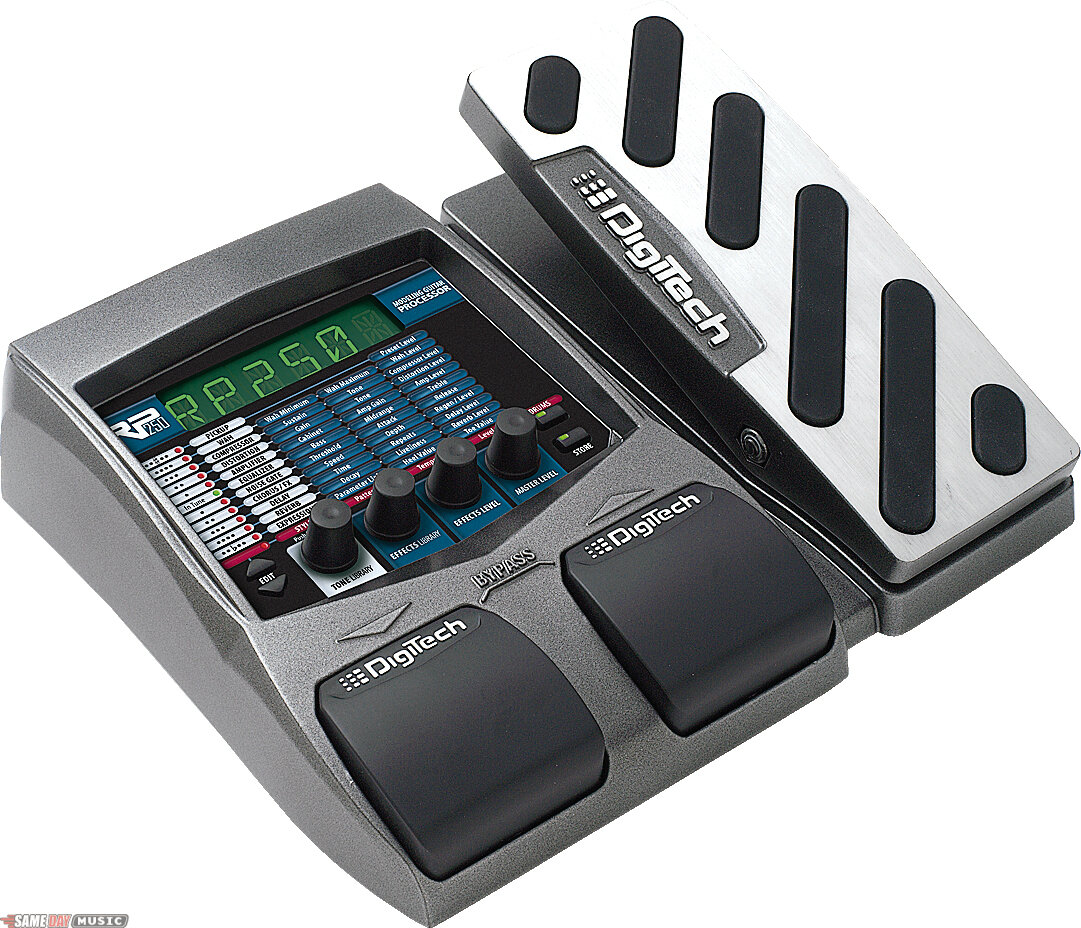 Today I've decided to talk a little bit about one of my favorite electric guitar accessories, the Digitech RP250 multi-effects pedal. This little machine is a great toy. It comes equipped with about 80 preset guitar effects, which can each be customized to your liking.
The Digitech RP250 comes equipped with such effects as chorus, multi-chorus, flanger, delay, reverb, whammy, auto-wah, auto-yah, pitch, and many more. Each effect has its own settings so you can find exactly what works for your desired sound.
Need some more customization? No problem. The Digitech RP250 allows you to choose the type of amplifier you want to play out of. In other words, this machine has the ability to produce a simulated sound that nearly matches the original sound of such amps as Fender, Ibanez, and more!
Ok fine...you need EVEN MORE customization settings. Each amplifier can be set to a specific amplifier cabinet so that you can really get a unique sound. From here, you have the option to play around with the equalizer settings, including bass, treble, and mid-tones. You can choose presets for the equalizer as well as customize the individual settings. This is a great feature on the Digitech RP250.
The built in wah pedal works great. This saves you a lot of money since a good wah pedal is usually over $100.
Another feature I love on the Digitech RP250 is the built-in drum machine. This thing has a great variety of beats, which can each be sped up or slowed down. You can also adjust the volume of the drums, change the drum style, or just turn it into a metronome.
Lastly, the Digitech RP250 has a built-in USB recording device, so you can simply plug it into your computer and record quality sound. The software is free and easy to download from the Digitech website.
Go get your hands on the Digitech RP250. It's under $200 and its worth much more!
Thursday, April 10, 2008
History of the Electric Guitar
I've decided to start off this electric guitar blog with a brief history of the electric guitar. I've always found it interesting to know the origin of the things I take for granted today. Since I love the electric guitar I figured why the hell not list the history on my electric guitar blog. Enjoy:
The concept of the electric solid body guitar developed from the popularity of Hawaiian music in the 1920s and 1930s. The electric Hawaiian guitars were the first instruments to produce sound electrically. And thus begun the history of the electric guitar.
The first electric guitar was created in the 1930s by a man named Adolph Rickenbacker. The first electric guitars had small soundholes in the body. This type of guitar is called a semi-hollow body electric guitar. This type of guitar is still popular today.
Further along in the history of the electric guitar comes the pickups. The first pickups used on the original electric guitars were called tungsten pickups. These electric guitar pickups made it possible to create guitars without the small soundholes. These were named solid body electric guitars or hard body electric guitars.
The electric guitar began to get more popular during the 30s and 40s. During this time of the history of the electric guitar, bands were starting to incorporate its sound in their music. They needed to have
louder guitars to be overheard by sections of their bands such as the brass sections. The acoustic guitars could not produce the necessary volume.
In the 1950s Gibson introduced Les Paul's unique guitar known as the Gibson Les Paul. This guitar is still around today and used by many excellent guitarists.
Then came Leo Fender. He designed the Fender Broadcaster which later became known as the Fender Stratocaster. This guitar is known as the Strat for short. The Fender Strat became an extremely popular guitar.
There you have it, a brief history of the electric guitar. Nothing intense, just a little something to help you appreciate the this great toy that we all take for granted! Keep checking back to my electric guitar blog for daily updates on the electric guitar.
The concept of the electric solid body guitar developed from the popularity of Hawaiian music in the 1920s and 1930s. The electric Hawaiian guitars were the first instruments to produce sound electrically. And thus begun the history of the electric guitar.
The first electric guitar was created in the 1930s by a man named Adolph Rickenbacker. The first electric guitars had small soundholes in the body. This type of guitar is called a semi-hollow body electric guitar. This type of guitar is still popular today.
Further along in the history of the electric guitar comes the pickups. The first pickups used on the original electric guitars were called tungsten pickups. These electric guitar pickups made it possible to create guitars without the small soundholes. These were named solid body electric guitars or hard body electric guitars.
The electric guitar began to get more popular during the 30s and 40s. During this time of the history of the electric guitar, bands were starting to incorporate its sound in their music. They needed to have
louder guitars to be overheard by sections of their bands such as the brass sections. The acoustic guitars could not produce the necessary volume.
In the 1950s Gibson introduced Les Paul's unique guitar known as the Gibson Les Paul. This guitar is still around today and used by many excellent guitarists.
Then came Leo Fender. He designed the Fender Broadcaster which later became known as the Fender Stratocaster. This guitar is known as the Strat for short. The Fender Strat became an extremely popular guitar.
There you have it, a brief history of the electric guitar. Nothing intense, just a little something to help you appreciate the this great toy that we all take for granted! Keep checking back to my electric guitar blog for daily updates on the electric guitar.
Subscribe to:
Posts (Atom)